

Paving Cost in Melbourne
23 September 2026
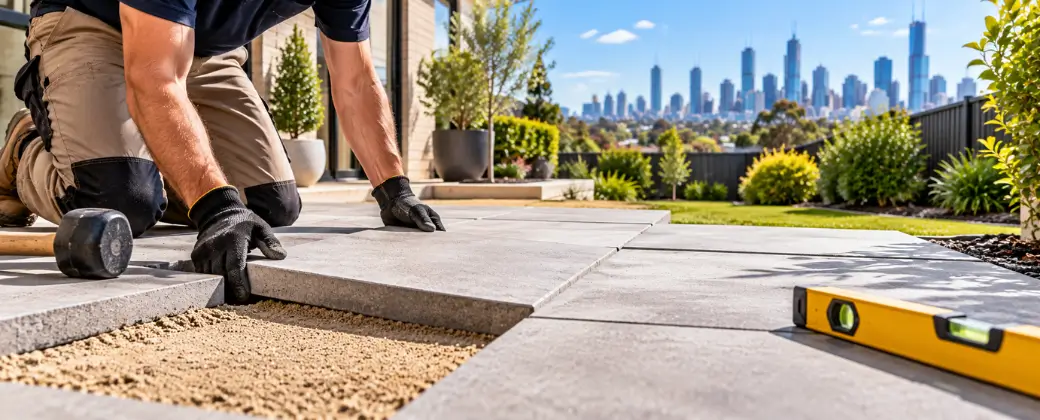
If you’re looking at a bare backyard, an old concrete area or a tired-looking path, paving can be a practical way to change the space without completely rebuilding it.
The difficult part is working out what the job is actually going to cost.
A small paved courtyard might be relatively straightforward, while a sloping backyard with poor access, old paving to remove and a complicated pattern can require considerably more preparation.
So, how much does paving cost in Melbourne?
For a straightforward residential paving job, a useful starting point is around $60 to $110 per square metre for concrete pavers supplied and laid. Brick and clay pavers generally sit higher, while natural stone can cost considerably more. A paved driveway is also more expensive because it needs a stronger base designed to handle vehicles. Victorian 2026 pricing guides currently put concrete pavers around $60-$110/m² and paved driveways around $90-$160/m².
For a small job, however, the square-metre price doesn’t tell the whole story. Excavation, removing old paving, waste disposal, access, edging and preparing the base can make a noticeable difference.
Here are useful starting figures for planning a residential project:
| Type of paving | Approximate Melbourne/Victoria price |
|---|---|
| Concrete pavers | From $60-$110/m² |
| Brick or clay pavers | From $70-$120/m² |
| Natural stone | From $90-$160/m² |
| Permeable pavers | From $80-$140/m² |
| Paved driveway | From $90-$160/m² |
| Basic paving labour | Depends on preparation and material |
| Removal of existing paving | Additional cost |
These are planning figures rather than a fixed quote. The condition of the site, amount of excavation, chosen pavers and access can all change the final price.
Another Australian 2026 pricing guide puts paving more broadly at about $40-$100/m² before the differences between materials and preparation are taken into account. That national range is useful for comparison, but Melbourne jobs can sit higher depending on the work involved.
Twenty square metres is roughly the size of a modest courtyard, small entertaining area or a reasonably sized garden section.
If you choose standard concrete pavers and the ground is already reasonably suitable, you might be looking at a few thousand dollars rather than a five-figure project.
For example, using a Melbourne/Victoria starting rate of $60-$110/m²:
That calculation is useful for understanding the paving itself, but it shouldn’t automatically be treated as the final project price.
If the area needs substantial excavation, new road base, removal of an old surface, drainage work or difficult access, those costs can sit outside the simple square-metre calculation.
This is one reason two paving quotes for apparently similar areas can be quite different.
Backyard paving is one of the more common residential jobs.
It might involve creating a new entertaining area, replacing grass beside a house, extending an existing patio or creating a paved section for outdoor furniture.
For a straightforward area using concrete pavers, $60-$110 per square metre is a useful starting range for the paving component in Melbourne and Victoria.
For a 30m² area, that gives a rough paving calculation of:
30m² × $60-$110 = $1,800-$3,300
Again, that’s not necessarily the final invoice.
A backyard that is already level and easy to access is a very different job from one where the installer needs to dig out soil, move large quantities of material through a narrow side passage and build up the base.
The preparation often matters just as much as the pavers you can see on the finished surface.
A paved patio can be relatively simple if the area is already prepared.
The cost will usually depend on:
Large-format concrete pavers can be quicker to lay than small individual pavers because there are fewer pieces to position. More complicated patterns take additional time because there is more measuring and cutting involved.
A basic 15-20m² patio using standard concrete pavers may therefore be considerably cheaper than the same-sized area using premium stone with a detailed pattern.
The paver itself is a major part of the budget.
Concrete pavers are popular because they come in a wide range of sizes, colours and finishes without necessarily reaching the price of natural stone.
Current Victorian estimates put concrete pavers around $60-$110/m².
They can work well for:
Brick and clay give outdoor areas a different appearance and are often chosen for traditional homes or properties where the paving needs to complement existing brickwork.
Allow roughly $70-$120/m² as a current Victorian planning range.
The final cost depends on the particular product and how it is laid.
Natural stone can create a very different finish from standard manufactured pavers.
Bluestone, sandstone, travertine and other stone products can cost substantially more than basic concrete pavers.
Current Victorian estimates put natural stone and bluestone at approximately $90-$160/m², although premium products can go well beyond this range.
Permeable paving is designed to allow water to pass through the surface and into the underlying system.
Current Victorian estimates put permeable pavers at around $80-$140/m².
The installation can be more involved because the base and drainage design need to suit the system.
When you look at a finished paved area, most of what you see is the pavers.
Underneath them is the part that determines how well the surface performs over time.
A paving job may require:
If the base isn’t prepared properly, pavers can move, sink or become uneven.
That is why a quote that appears cheap because it excludes preparation isn’t necessarily comparable with another quote that includes excavation and base work.
Current Australian cost information puts base preparation at roughly $25-$55/m² depending on the work involved.
Replacing an old paved area is different from paving a new section of prepared ground.
Someone may want to replace old pavers because they have:
The old pavers need to be lifted before the new surface can be prepared.
There may also be a significant amount of waste to remove from the property.
If the existing base is still suitable, some of the preparation may be simpler. If the base has failed, it may need to be removed and rebuilt.
This is why it is difficult to give a useful fixed price for paver replacement in Melbourne without seeing the existing area.
Driveway paving needs to be treated differently from a garden path or patio.
Cars place much greater loads on the surface, so the underlying base needs to be suitable for vehicle traffic.
A current Victorian guide puts paved driveways at approximately $90-$160/m².
The final price can also be affected by:
If you’re considering paving a driveway, don’t compare quotes purely by the price of the pavers.
The preparation underneath the driveway is important.
Victoria’s Building and Plumbing Commission states that a building permit isn’t required simply for constructing a driveway or laying paving. However, paving can affect drainage and other plumbing considerations, so homeowners are advised to check with their local council where appropriate.
Driveway crossovers can have additional council requirements, so it’s sensible to check with the relevant Melbourne council before starting work.
If you’re trying to keep the project within budget, these are some of the things worth considering before work begins.
A backyard with direct side access is easier to work on than a property where every paver, bag of bedding material and load of base has to pass through the house.
Restricted access can increase labour time.
A slope can require additional excavation, levelling and preparation.
The finished paving also needs to manage water correctly rather than simply following the existing ground level.
It might seem logical that a 10m² job should cost exactly half as much as a 20m² job.
In practice, it doesn’t always work that way.
There are fixed costs involved in travelling to the property, setting up, preparing the area and bringing equipment to site.
Straight rows are generally quicker than intricate patterns.
Herringbone, borders, circles, curves and combinations of different-sized pavers can all increase labour because more measuring and cutting is involved.
Water needs somewhere to go.
If the paving is being installed against a house, around a patio or across an area where water already collects, drainage needs to be considered before the pavers are laid.
Old concrete, damaged paving and other hard surfaces may need to be broken up and removed before the new work can begin.
That can add considerably to a small project.
It depends on the particular project.
Standard concrete can be competitive on price, particularly over larger areas. Pavers have the advantage that individual damaged units can generally be replaced rather than removing an entire slab.
Paving can also give you more flexibility with patterns, colours and materials.
For outdoor paving, current Australian cost guides show concrete pavers broadly around $30-$100/m² depending on the product, while natural stone can be substantially higher. Labour and preparation are additional considerations.
So rather than asking which is always cheaper, compare the complete installed cost for the same area and the same site conditions.
For smaller paving and repair jobs, a handyman may be suitable, particularly where the work doesn’t involve a major structural alteration or specialist landscaping project.
A handyman may be able to help with jobs such as:
Larger driveways, major excavation, drainage work or extensive landscaping may require a more specialised contractor.
The right choice depends on the size and complexity of the job.
Paving isn’t limited to residential backyards.
Businesses can use paving for:
For a commercial property, keeping access to the building open can also be important. The work may need to be organised around customers, staff and trading hours.
If you’re a property manager looking after several Melbourne properties, smaller paving repairs can also be dealt with alongside other maintenance jobs rather than waiting until a small damaged section becomes a much bigger problem.
You don’t necessarily need to wait for someone to visit before providing useful information.
When contacting a paving contractor or handyman, have these details ready:
A few photographs can make a big difference.
For example, a 20m² backyard area with wide side access and an existing level base is a very different job from a 20m² area that has to be excavated and accessed through a narrow laneway.
If you have a small paving job around your Melbourne property, Get Handyman can help assess the work and discuss what is involved.
Whether you’re replacing a handful of damaged pavers or planning a small paved courtyard, the important thing is to look at the whole job rather than focusing only on the price per square metre.
For standard concrete pavers, a reasonable starting point in Melbourne is around $60-$110/m² supplied and laid, while driveway paving and premium materials can cost more.
Send us the Melbourne suburb, approximate area and a few photos of the paving, and we can discuss the job and provide a quote based on the actual work required.
Standard concrete pavers in Melbourne and Victoria currently start at roughly $60-$110 per square metre supplied and laid. Brick and clay pavers generally cost more, while natural stone is higher again. Preparation, access and the condition of the ground can change the final price.
Standard concrete pavers are generally one of the more affordable paving options. Current Victorian pricing starts at around $60/m² supplied and laid, although a small job may have a higher effective cost once preparation, transport and other fixed costs are included.
Using a starting range of $60-$110/m², the paving component for 20m² works out to roughly $1,200-$2,200. Excavation, base preparation, old paving removal, drainage and other site work can increase the total.
At $60-$110/m², 30m² of standard concrete paving works out to approximately $1,800-$3,300 for the paving component. The final project cost depends on how much preparation the backyard needs.
A paved driveway currently costs around $90-$160/m² as a Victorian planning range. Driveways cost more than many patios or garden paths because they need a suitable vehicle-rated base and may involve additional crossover or drainage work.
There isn’t one answer for every project. Standard concrete can be less expensive over some large areas, while pavers offer different materials, patterns and the ability to replace individual units. The best comparison is the complete installed cost for your particular site.
A small, straightforward paving area may take only a few days, while larger areas, difficult access, excavation, drainage or complicated patterns can extend the job. The actual timeframe depends heavily on site preparation.
Sometimes, but it depends on the condition, levels, drainage and height of the existing concrete. Simply covering a damaged or unsuitable surface isn’t always appropriate. The existing surface should be assessed before deciding how to proceed.
The difference is often in what’s included. One quote may cover excavation, base preparation, waste removal and edging, while another may only cover laying the pavers. Material quality, access, drainage and pattern complexity can also create large differences.
Not necessarily. Many paving systems use a properly prepared and compacted granular base with a bedding layer rather than a concrete slab. The appropriate construction depends on the type of paving and how the surface will be used.
Yes, but driveway paving needs a base designed for vehicle loads. A base suitable for a garden path shouldn’t automatically be assumed to be suitable for cars.
For smaller areas, yes. Individual pavers can sometimes be lifted, the underlying material corrected and the pavers relaid. If widespread movement is caused by a failed base, drainage problem or tree roots, more extensive work may be needed.
The Building and Plumbing Commission says a building permit isn’t required for constructing a driveway or laying paving. However, driveway crossovers, drainage and local council requirements can still apply, so check with the relevant council for your property.

Services
Copyright © 2026 Get Handyman. All rights reserved